
Why I Still Keep a Sketchbook as a Modern Designer
Modern designers have access to an absurd amount of creative technology. I can sit down with an iPad or computer and move between illustration, graphic design, photo editing, video, animation, 3D modeling, typography, and web design without ever touching a physical piece of paper. The tools available to independent creatives today would have required an entire studio, a collection of specialized equipment, and a considerable amount of money not that long ago. I love those tools, and I use them every day. But despite having access to more creative technology than I could have imagined when I first started making art, I still keep a sketchbook.
As a designer and illustrator, I’ve found that some of my most important creative thinking happens before I open any software at all. Through my work with Seven Spirit Media, I spend a lot of time thinking about how ideas eventually become finished things: websites, advertisements, illustrations, branding, videos, layouts, and other forms of visual media. A sketchbook exists before all of that. It is one of the few places where an idea doesn’t have to be useful, polished, marketable, optimized, or even particularly good. For modern designers surrounded by increasingly powerful tools designed to help us produce finished work faster, I think having a place where nothing needs to be finished is more important than ever.
Design Software Is Powerful, but It Also Shapes How We Think
Creative software has become incredibly good at helping us make things. Modern design tools give us grids, guides, fonts, brushes, templates, effects, stock libraries, color palettes, adjustment layers, components, presets, and increasingly sophisticated forms of automation. Once I know what I want to create, those tools allow me to move from an idea to finished work incredibly quickly. That efficiency is one of the reasons digital tools are such an important part of my professional workflow, but efficiency can also influence the way we approach the creative process itself.
The problem begins when the software starts determining the idea. Open a design program and you’re immediately presented with possibilities that have already been defined for you. There are menus, tools, established workflows, templates, and examples showing you what finished things are supposed to look like. Without realizing it, designers can begin making decisions according to what their software makes convenient rather than what the original idea actually needs.
A blank sketchbook page is different. There isn’t a font menu, stock image library, alignment button, template, or undo command waiting to guide the process. There is simply an empty piece of paper and whatever happens when you begin making marks on it. That limitation is precisely what makes the sketchbook useful. Instead of asking what a particular piece of software allows me to do, I can concentrate entirely on discovering what the idea might become.
A Sketchbook Lets Me Think Before I Design
I don’t necessarily think of everything inside my sketchbook as “drawing.” Some of it certainly is. I’ll draw characters, faces, figures, environments, objects, symbols, compositions, or whatever else happens to interest me at the time. But there are also notes, arrows connecting unrelated thoughts, thumbnails, strange shapes I don’t completely understand yet, and words scribbled beside drawings. There are compositions that go nowhere and characters that might never exist outside that particular page. Sometimes I’ll return to an idea months or years later, while other ideas disappear into a closed sketchbook and are never touched again. Both outcomes are completely fine.
The important part is that I was able to externalize the thought before worrying about how it would eventually be produced. That is one of the reasons I believe sketchbooks remain useful for graphic designers, illustrators, web designers, animators, and other visual creatives even when their final work will be entirely digital. A sketchbook isn’t simply somewhere to practice drawing. It is somewhere to think visually, and visual thinking remains at the heart of design regardless of what medium ultimately gets used to create the finished work.
Your Sketchbook Does Not Need to Be a Portfolio
One of the worst things you can do to a sketchbook is become overly concerned with making every page impressive. Social media probably hasn’t helped us here. We’re constantly exposed to beautiful sketchbook tours filled with immaculate drawings, perfectly composed spreads, elaborate illustrations, and pages that sometimes look more polished than finished artwork. There is absolutely nothing wrong with making beautiful sketchbooks, but that isn’t the standard a working sketchbook needs to meet.
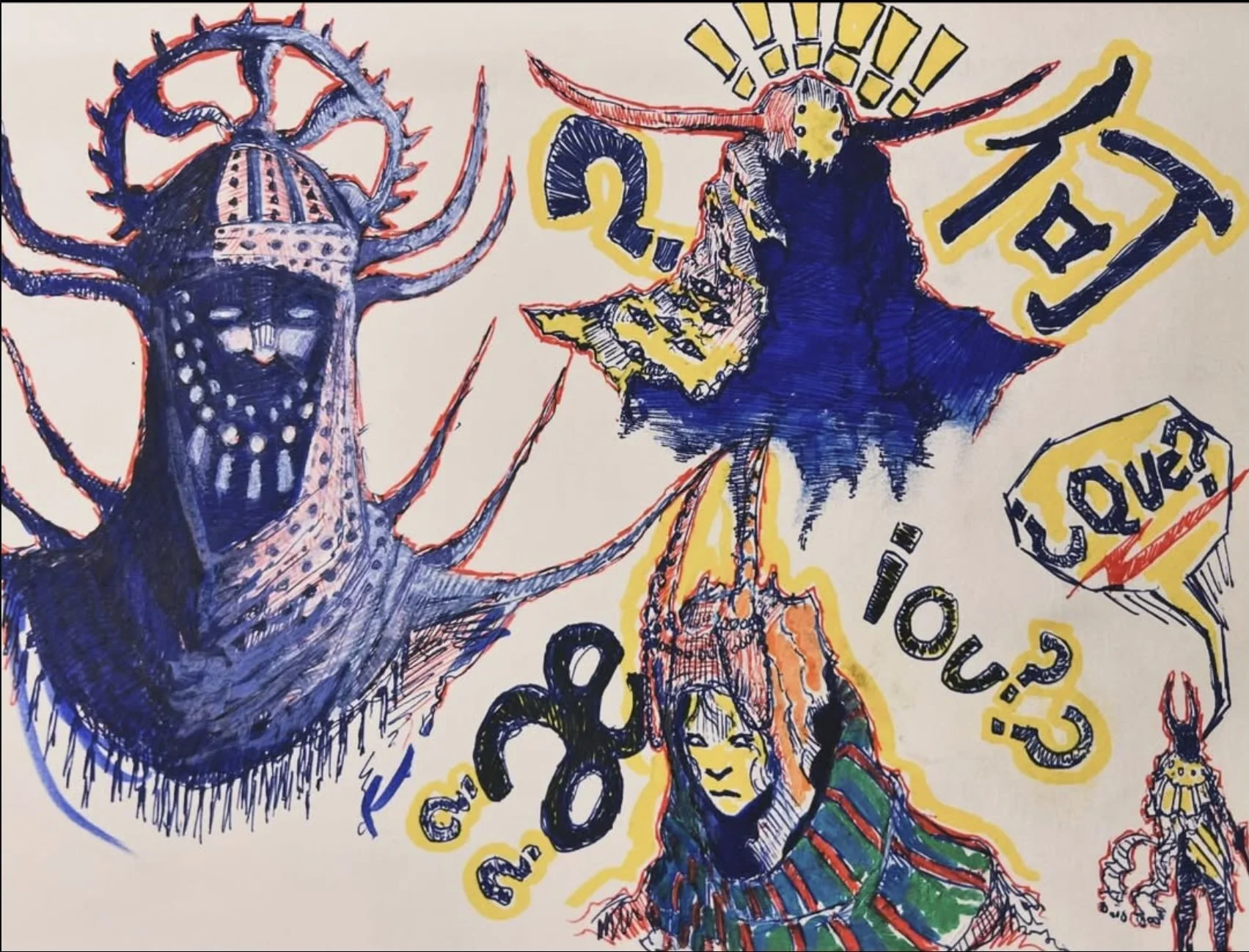
My own sketchbooks can get chaotic. A carefully rendered drawing might be sitting beside a stupid little doodle. A character design can collide with some handwritten thought I had that afternoon. I might start drawing something, realize it isn’t working, abandon it halfway through, and begin something completely unrelated six inches away. The sketchbook image accompanying this article is a good example. There are characters, symbols, questions, repeated shapes, different colors, loose marks, and competing visual ideas sharing the same space. It isn’t trying to be a finished illustration. It is a record of exploration, and for me, that makes the page far more useful than if I had approached it as something that needed to be presentable.
Bad Drawings Can Produce Good Ideas
Professional designers spend a lot of their lives producing things that other people will eventually judge. Clients judge them, creative directors judge them, customers judge them, audiences judge them, and perhaps more relentlessly than anyone else, we judge them ourselves. That creates an understandable temptation to make everything look finished as quickly as possible. Once you have enough technical experience, it becomes surprisingly easy to start polishing an idea before you’ve actually determined whether the idea deserves to be polished.
A sketchbook gives me somewhere to resist that instinct. I can make a terrible drawing in thirty seconds, and that terrible drawing might still contain a good idea. Maybe the proportions are wrong but the silhouette is interesting. Maybe the perspective is broken but the composition works. Maybe a character looks ridiculous but one piece of the costume becomes something worth developing. Maybe a page filled with completely unrelated drawings accidentally creates a relationship between two ideas I wouldn’t have discovered otherwise.
The drawing doesn’t have to succeed for the thinking behind it to succeed.
That distinction is important because sketching allows ideas to fail cheaply. Instead of spending three hours polishing the first concept that enters my head, I can explore ten possibilities and throw nine of them away. Those abandoned sketches aren’t wasted effort. Exploring, eliminating, changing, combining, and occasionally completely misunderstanding ideas is part of design.
Drawing by Hand Forces Me to Look Differently
You do not need to be an illustrator to benefit from drawing, and I think this is something designers occasionally misunderstand when the subject of sketchbooks comes up. The purpose isn’t necessarily to become technically brilliant at drawing the human figure or rendering photorealistic objects. Those are separate disciplines that require their own study. The broader value for designers comes from learning how to observe and translate what they see into visual decisions.
When you draw something, you have to decide where one shape ends and another begins. You begin noticing how large one object is compared with another, where negative space forms, which details actually matter, where the viewer’s eye is moving, and what happens when a shape is exaggerated or simplified. You begin thinking about what makes a silhouette recognizable and how much information can be removed before an image stops communicating what you intended.
Those are drawing questions, but they are also design questions. Hierarchy, proportion, rhythm, contrast, balance, shape, movement, and composition exist whether I’m drawing a strange character in a sketchbook or creating a commercial layout for a client through Seven Spirit Media. The medium changes, but the underlying visual thinking does not.
The Mistakes Are Part of the Point
One of the greatest advantages of digital art and design is our ability to correct things. Undo, transform tools, masks, layers, selections, perspective correction, vector handles, and countless other digital conveniences make it possible to revise work without destroying everything around it. I use those capabilities constantly, and I certainly wouldn’t want them to disappear.
Physical media doesn’t always cooperate in the same way. Ink goes somewhere you didn’t intend. A line gets too thick. Your proportions drift. Two drawings overlap because you underestimated how much room was left on the page. You make a mark and immediately realize you hate it. Because there isn’t always an easy way to remove the mistake, you have to respond to it instead.
Sometimes the answer is simply that the drawing is ruined, and that’s fine. Occasionally, however, the mistake produces something more interesting than what you originally intended. The unexpected line becomes part of a silhouette. An accidental overlap suggests a composition. A distorted feature gives a character more personality. A mark you would have immediately undone digitally forces you to reconsider what you’re looking at. Instead of simply executing a predetermined solution, you begin reacting to what is happening on the page, and those accidents can become enormously valuable to the creative process.
A Sketchbook Gives Me Somewhere Without an Algorithm
There’s another reason I’ve become increasingly protective of analog creative spaces: a sketchbook is private by default. I don’t have to post it, photograph it, optimize it, caption it, or turn it into content. Nobody needs to like it or comment on it. The page doesn’t need a thumbnail, and it certainly doesn’t need to perform for an algorithm.
That distinction matters in a creative culture where making things and publishing things have become increasingly intertwined. When every drawing can potentially become content, it’s easy to unconsciously begin asking what other people will think about an idea before you’ve even figured out what you think about it yourself. Eventually, that pressure can influence not only what you publish but what you allow yourself to explore in the first place.
The sketchbook interrupts that process. I can draw something simply because I’m curious about it. Some of those experiments might eventually become work that I share through Seven Spirit Media or develop further as an illustrator. Others will remain buried in a sketchbook that almost nobody will ever see. Their value isn’t determined by the size of their audience because the act of exploring the idea was already useful.
Analog and Digital Work Don’t Need to Compete
I don’t romanticize traditional tools at the expense of digital ones. I’ve spent enough of my life working with both to know that arguments about whether traditional or digital art is somehow more “authentic” aren’t particularly useful to me. They’re tools, and different tools are useful at different stages of the creative process.
I paint and draw traditionally, but I also work digitally. Depending on the project, I might move through several different mediums before something is finished. A drawing might begin on paper, move to an iPad, incorporate a 3D reference, get painted digitally, become part of a video, and eventually appear on a website. None of those processes contradict one another. They are different stages of developing and executing an idea.
The sketchbook simply occupies a particularly useful position near the beginning of that chain because the barrier between thought and action is almost nonexistent. There is no file setup, canvas configuration, software loading, or decision about which application is best for the job. I can pick up a pen, make a mark, respond to it, and see what happens. Sometimes that simplicity is exactly what I need.
Sketchbooks Become Records of Creative Development
There’s something strange about looking through an old sketchbook. You remember ideas you’d completely forgotten, find drawings that make you wonder what the hell you were thinking, and occasionally discover something surprisingly good that you barely remember making. The most interesting part, though, is noticing patterns that were almost impossible to recognize while you were creating the individual pages.
Certain shapes keep appearing. Particular subjects refuse to disappear. You realize you’ve been drawing variations of the same character or exploring the same visual idea for years without consciously recognizing it. Symbols recur, compositions repeat themselves, and questions you thought were new turn out to be questions you’ve been trying to answer for a decade. A single drawing might not tell you much about your creative development, but hundreds of pages accumulated over several years certainly can.
Over time, a sketchbook becomes a physical record of how your visual language developed. For someone who works professionally in creative fields, I think that is enormously valuable. You aren’t simply documenting what you made at a particular point in your life. You are documenting how you learned to see, what repeatedly captured your attention, and how those interests gradually became part of your identity as a designer and artist.
Why Sketchbooks May Matter Even More in the Age of AI
There is an obvious new dimension to this conversation because creative technology isn’t slowing down. Generative AI can produce visual concepts in seconds, while design applications increasingly automate selections, layouts, image manipulation, editing, asset creation, and other tasks that once consumed substantial portions of a designer’s time. Those tools will continue improving, and the distance between having an idea and producing something polished will probably continue shrinking.
I use modern technology because refusing useful tools simply because they’re new has never struck me as a particularly interesting creative philosophy. At the same time, faster production makes having something worth producing even more important. When technology makes execution easier, the ability to generate a polished image is no longer necessarily the difficult part of the creative process. Deciding what you actually want to communicate, why you want to communicate it, and what makes the idea worth pursuing becomes increasingly important.
A sketchbook won’t answer those questions for you, but it gives you somewhere to wrestle with them without immediately demanding a finished result. The value of drawing by hand isn’t that a pencil can somehow outperform a computer. The value is that slowing down creates a different kind of thought. When production becomes faster and easier, meaningful exploration becomes more important, not less.
Designers Need Somewhere They Are Allowed to Be Bad
Creative professionals become very good at editing themselves. You learn what clients expect, understand conventions, recognize what looks professional, and accumulate a library of solutions that experience tells you will probably work. That knowledge is incredibly useful, but it can also become dangerous. Eventually, you can become so efficient at making things that work that you stop discovering things you didn’t already know how to make.
The sketchbook gives me somewhere to fight against that. I can draw badly, misunderstand anatomy, create an awful composition, write something pretentious in the margin and laugh at myself six months later, or chase an idea that leads absolutely nowhere. Nobody has paid me for that page. Nobody is waiting for a revision. Nothing needs to be exported, delivered, approved, or published.
The goal isn’t to become better at keeping a sketchbook. The goal is to give yourself somewhere you’re allowed to think badly.
Somewhere inside all that mess might be something I haven’t thought of before. That possibility is worth considerably more to me than having a sketchbook where every page looks impressive.
Keep the Sketchbook Messy
If you’re a designer who hasn’t drawn traditionally in years, you don’t need an expensive sketchbook, professional markers, an elaborate daily drawing challenge, or another productivity system disguised as a creative habit. Buy some paper, find something that makes marks, and start using it. Draw objects around you, thumbnail compositions, redesign something you saw that bothered you, sketch characters, write notes, study typography, invent symbols, copy interesting shapes, or fill pages with things that make absolutely no sense.
Most importantly, don’t worry about whether any of it belongs together. Professional creative work will eventually demand organization, refinement, technical precision, and a finished product. Your sketchbook doesn’t have to. Its usefulness comes partly from being one of the places where those expectations can disappear.
The Sketchbook Is Still Part of My Design Process
My professional creative work through Seven Spirit Media, operated by Seven Spirit Thread Company LLC, depends heavily on modern digital tools. That’s unavoidable when working across contemporary graphic design, web design, illustration, branding, video, and digital media. I’ve watched creative technology evolve dramatically throughout my career, changed software, learned new workflows, and incorporated new tools whenever they genuinely improve the way I work. None of that has made my sketchbooks obsolete.
If anything, those advances have made me appreciate them more. A sketchbook provides something my professional software isn’t supposed to provide: a place where there is no distinction yet between the good idea and the stupid one. That is where experimentation happens, visual language develops, and an idea can appear before I understand what I’m eventually going to do with it.
I’m Rieley Finn, a designer, illustrator, artist, and owner of Seven Spirit Media, the creative brand of Seven Spirit Thread Company LLC. I’ve worked with plenty of sophisticated creative tools over the years, and I’ll undoubtedly work with increasingly sophisticated ones in the future. But sometimes the most useful thing I can do for my work is still remarkably simple: open a sketchbook, make a mark, and figure out what happens next.
Explore 404 Nt Fund, Seven Spirit & the Full Content Ecosystem
Website Portfolio:https://rieleyfinn.com/
YouTube:https://www.youtube.com/@404-Nt-Found
Medium:https://medium.com/@rieleyfinn
Substack:https://substack.com/@rieleyfinn
TikTok:https://www.tiktok.com/@sevenspiritmedia
Instagram:https://www.instagram.com/sparrow_finn/
Pinterest:https://www.pinterest.com/sparrow_finn/_profile/
X (Twitter):https://x.com/RieleyFinn