
Why Every Artist Should Study More Than Art
By Rieley Finn | Seven Spirit Media
People often assume that becoming a better artist means spending more time studying art. Draw more. Paint more. Learn another software package. Master anatomy. Improve perspective. Refine composition. While all of those skills are essential, they only tell part of the story.
Art has never existed in isolation.
Every meaningful work of art is built upon ideas that come from somewhere else. The greatest artists throughout history were rarely confined to a single discipline. They studied mathematics to understand proportion, architecture to understand structure, biology to understand life, philosophy to understand existence, and theology to explore humanity's oldest questions. Their artwork became stronger because their understanding of the world became deeper.
As digital artists, we have inherited something extraordinary. Our medium allows us to combine illustration, photography, typography, design, animation, programming, sound, and storytelling into a single piece of work. Digital art is not simply another artistic medium—it is the convergence of countless disciplines into one creative language.
That means our education should be just as broad.
Mathematics may seem like an unlikely place to find artistic inspiration, but patterns govern nearly everything we perceive as beautiful. The Fibonacci sequence, symmetry, fractals, topology, probability, and geometry all appear naturally throughout the world. Whether we consciously recognize them or not, these mathematical relationships influence composition, rhythm, balance, and visual harmony. Understanding these concepts allows artists to create work that feels structured without becoming rigid, complex without becoming chaotic.
Science offers another layer of understanding. Physics explains the behavior of light, shadow, color, and movement. Biology reveals the incredible diversity of life, from microscopic organisms to the evolution of complex ecosystems. Neuroscience begins to answer why certain images evoke emotional responses while others leave us unaffected. Every scientific discovery provides another perspective through which an artist can interpret reality.
Psychology teaches us that people rarely respond to images for purely visual reasons. Symbols carry emotional weight. Colors trigger associations. Shapes influence perception. Memory, fear, nostalgia, curiosity, and expectation all affect how viewers experience an artwork. Understanding these ideas allows artists to communicate with greater intention instead of relying solely on aesthetics.
History reminds us that every artistic movement emerged from cultural change. Gothic cathedrals, Renaissance paintings, Japanese woodblock prints, Bauhaus design, Surrealism, Abstract Expressionism, and contemporary digital illustration all reflect the societies that produced them. Studying history teaches us that art is not simply decoration—it is documentation. It records how civilizations understood themselves and the world around them.
Perhaps no discipline has influenced visual art more consistently than theology and philosophy. Regardless of personal belief, religious traditions have shaped architecture, painting, sculpture, literature, music, symbolism, and mythology for thousands of years. Sacred geometry, archetypal narratives, ritual, iconography, and moral questions continue to appear throughout contemporary art because they address ideas that remain fundamentally human. Likewise, philosophy challenges artists to ask questions that cannot be answered with a single image. What is identity? What makes something beautiful? What does it mean to exist? These questions become fertile ground for creative exploration.
For me, studying these subjects is not about becoming an expert in each of them. It is about recognizing that every discipline reveals another piece of reality. Art becomes the place where those pieces come together.
When I create digital artwork, I am not simply thinking about composition or color. I am considering symbolism, visual language, historical reference, philosophical ideas, typography, texture, psychology, and design simultaneously. Every layer has a purpose. Every visual decision exists because it connects to something larger than itself.
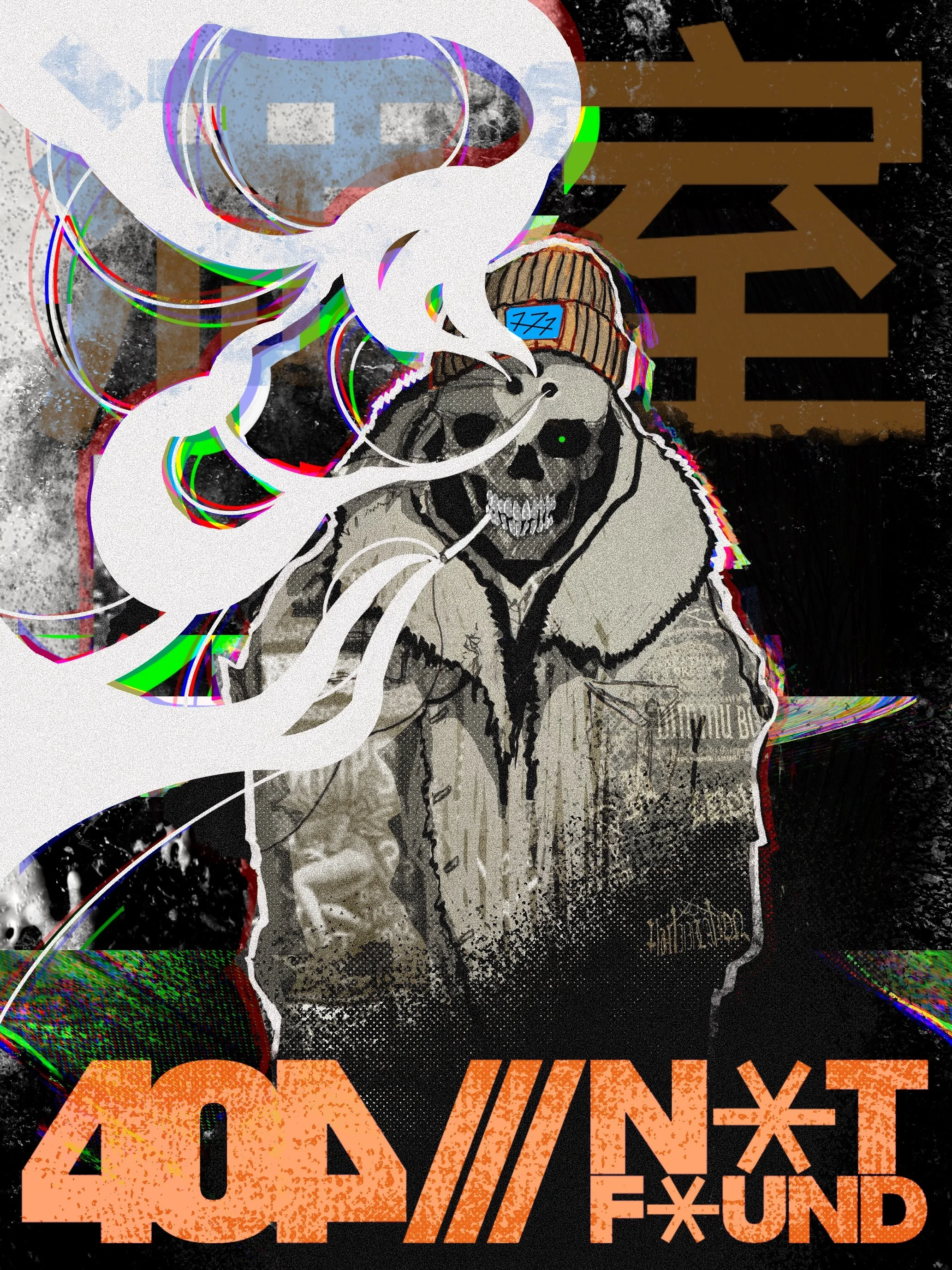
The artwork accompanying this article reflects that philosophy. It combines distressed textures, layered typography, symbolic imagery, digital interference, and graphic abstraction into a single composition. At first glance it may appear chaotic, but beneath the surface are influences drawn from multiple fields of study. The work is not intended to provide answers. It is intended to encourage questions.
That, perhaps, is the most important role of art.
In an age where information is limitless and attention spans continue to shrink, artists have an opportunity to create work that rewards curiosity. An image can become more than something to admire. It can become an invitation to explore ideas beyond the frame.
The future of digital art will not belong solely to those who master new software or adopt the latest technology. Those skills will always matter, but they are tools rather than destinations. The artists who leave lasting impressions will be those who continue learning long after they have mastered technique.
Study mathematics, not because you want to become a mathematician, but because patterns shape beauty.
Study science because understanding reality allows you to reinterpret it.
Study psychology because every image is ultimately experienced by another mind.
Study history because every new idea has roots in the past.
Study philosophy because questions often inspire greater art than answers.
Study theology because symbols have carried human meaning for thousands of years.
Most importantly, remain curious.
Art is not the end of education. It is the visible expression of everything we choose to learn.
Explore 404 Nt Fund, Seven Spirit & the Full Content Ecosystem
Website Portfolio: https://rieleyfinn.com/
YouTube: https://www.youtube.com/@404-Nt-Found
Medium: https://medium.com/@rieleyfinn
Substack: https://substack.com/@rieleyfinn
TikTok: https://www.tiktok.com/@sevenspiritmedia
Instagram: https://www.instagram.com/sparrow_finn/
Pinterest: https://www.pinterest.com/sparrow_finn/_profile/
X (Twitter): https://x.com/RieleyFinn